
GLODAPv3 released in July 2026
The Global Ocean Data Analysis Project (GLODAP) is a synthesis activity for ocean surface to bottom biogeochemical data collected through chemical analysis of water samples. Observations of 13 core variables (temperature, salinity, oxygen, phosphate, nitrate, silicate, dissolved inorganic carbon, total alkalinity, and the transient tracers CFC-11, CFC-12, CFC-113, CCl4 and SF6) are subjected to primary and secondary quality control to identify outliers and correct for systematic differences between cruises. The goal is to create a data product that is as consistent as possible, within our measurement capabilities. GLODAP may be wrong, but it is at least consistently wrong.
Merged and Adjusted Data Product – v3 is accessible on the GLODAP website
Click here to download the GLODAPv3 release poster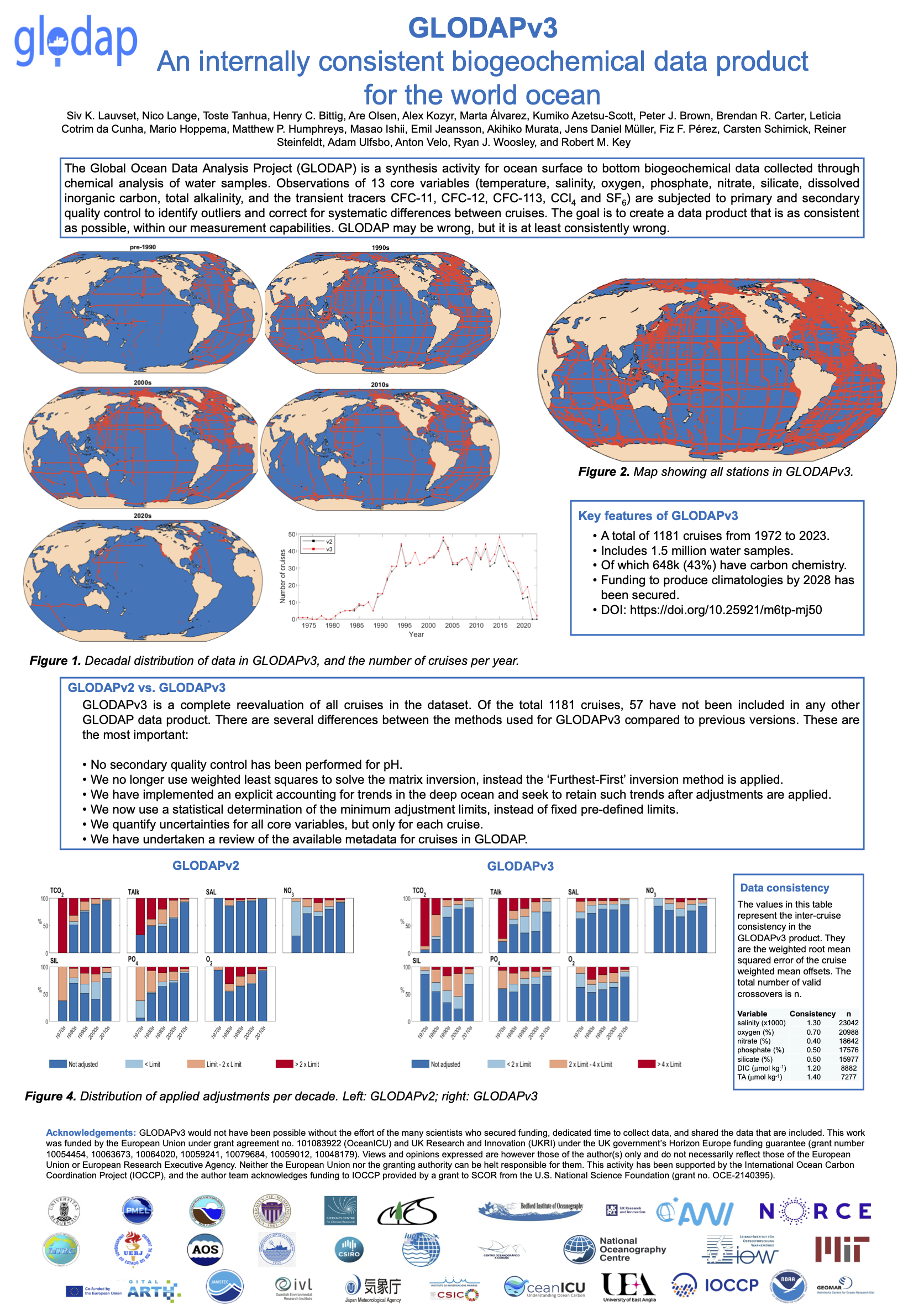
GLODAP: Background and history
Synthesis of ocean interior carbon and carbon-relevant data has been supported by IOCCP since the beginning of the project. Such data are of fundamental importance for accurate assessments of oceanic carbon inventories and uptake rates, and for model validation.
Initially, three separate efforts were supported: GLODAP(v1.1), CARINA, and PACIFICA. The resulting three products, in combination with hundreds of newly assembled cruise datasets, were combined in GLODAPv2 (2016), harmonizing all available ship-based carbon-relevant data into one global synthesis product. For GLODAPv2, all cruise data were fully (re-)evaluated. Subsequent annual updates of GLODAPv2 (between 2019 and 2023) added newly obtained cruise data and evaluated them against the GLODAPv2 reference dataset.
In line with the decadal GO-SHIP strategy, GLODAPv2 and its annual updates are now replaced by the new GLODAP version three, GLODAPv3. For this major version release, all cruise data have again been completely re-evaluated. Rigorous and ever-improving data quality control (QC) procedures, designed to assure the highest possible internal data quality and consistency, form the foundation of all GLODAP syntheses. IOCCP continues to support this challenging effort.
GLOBAL OCEAN DATA ANALYSIS PROJECT
The GLobal Ocean Data Analysis Project (GLODAP) is a cooperative effort to coordinate global synthesis projects funded through the U.S. National Oceanic and Atmospheric Administration (NOAA), the U.S. Department of Energy (DOE), and the National Science Foundation (NSF) as part of the Joint Global Ocean Flux Study - Synthesis and Modeling Project (JGOFS-SMP). Cruises conducted as part of the World Ocean Circulation Experiment (WOCE), JGOFS, and the NOAA Ocean-Atmosphere Exchange Study (OACES) over the decade of the 1990s have created an oceanographic database of unparalleled quality and quantity. These data provide an important asset to the scientific community investigating carbon cycling in the oceans. The central objective of this project is to generate a unified data set to help determine the global distributions of both natural and anthropogenic inorganic carbon, including radiocarbon. These estimates provide an important benchmark against which future observational studies will be compared. They also provide tools for the direct evaluation of numerical ocean carbon models.
ATLANTIC OCEAN CARBON SYNTHESIS GROUP
This project was initiated at the IOCCP-CarboOcean Initial Atlantic Ocean Carbon Synthesis Meeting, June 28-30 2006, Laugarvatn, Iceland. The meeting brought together 23 participants from 9 countries with expertise ranging from ship-based hydrography and carbon measurements, physical oceanography, surface pCO2 variability, CFC and tracer measurements, O2 on profiling floats, modeling, and data synthesis and management. During the meeting it was decided that the CARINA (Carbon in the Atlantic) data synthesis should be extended to include the Arctic and Southern Oceans. The Workshop participants developed three coordinated synthesis groups and a common data module:
- North Atlantic working group (lead: Are Olsen, Bjerknes Center for Climate Research, Bergen, Norway)
- Atlantic working group (lead: Toste Tanhua, IFM-GEOMAR, Kiel, Germany)
- South Atlantic / Southern Ocean (lead: Mario Hoppema, AWI, Bremerhaven, Germany)
- Data: Robert Key, Princeton University, USA
These groups met three times after the Iceland meeting; in Kiel, Germany (March 2007), Delmenhorst, Germany (December 2007) and Paris, France (June 2008) to tune the methodology and evaluate the results. Further more, an interactive website was developed that allowed the different investigators to upload and view results of the synthesis. By the end of 2008, the CARINA secondary quality control was finalized. After this the individual cruise data in WOCE exchange format, as well as three merged data products, were published on CDIAC (CARINA at CDIAC) and on CCHDO (CARINA at CCHDO). Working documents, and updates on follow-up activities are also available from the CDIAC website. In addition to these data, an ODV collection and Matlab routines to facilitate reading the data was added to the CIDAC site. The documentation of the CARINA project is primarily done through 20 articles published in a special issue in Earth System Science Data.
NORTH PACIFIC CARBON SYNTHESIS GROUP
This synthesis activity was launched with a workshop entitled “Understanding North Pacific Carbon-Cycle Changes: A Data Synthesis and Modeling Workshop”, held in Seattle in June 2004. This workshop was sponsored by NOAA's Global Carbon Cycle Program with additional support from the North Pacific Marine Science Organization (PICES), The Global Carbon Project (GCP), and the University of Washington Program on Climate Changes (UWPCC). This workshop addressed 3 primary questions:
- 1. How are air-sea CO2 fluxes in the North Pacific affected by different modes of variability?
- 2. How and why are the North Pacific distribution patterns of carbon, nutrients and oxygen in the water column changing with time?
- 3. What are the requirements for detecting a climate change signal in the North Pacific carbon cycle?
A special section of the Journal of Geophysical Research entitled “North Pacific Carbon Cycle Variability and Climate Change” was published in 2006 (C. Sabine and N. Gruber, guest editors, Introduction doi:10.1029/2006JC003532). In 2005 this international collaboration was further formalized with the formation of the PICES Section on Carbon and Climate. A major data synthesis effort subsequently got underway. This project was known as PACIFICA and was coordinated by M. Ishii (Japan) and R. Key (United States). This project has adopted many of the methodologies developed by CARINA in the Atlantic and was expected to be completed in early 2013.